
Site of Special Scientific Interest
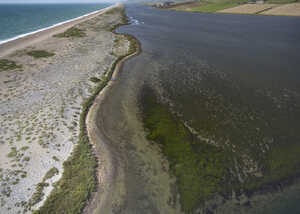
Chesil and the Fleet was designated a Site of Special Scientific Interest (SSSI) in 1986, notified under Section 28 of the Wildlife and Countryside Act 1981 as amended.
Chesil Beach is one of the three major shingle structures in Britain and is of international importance for coastal geomorphology. Along about half its length, it encloses the Fleet, the largest tidal lagoon in Britain. This, together with the beach and associated habitats, comprises a site of international importance for wildlife. The fossil-rich and stratigraphically important sequence of Jurassic strata exposed along the landward side of the Fleet adds further value to the site.
It is an offence to intentionally or recklessly damage, disturb or destroy land known to be an SSSI or intentionally or recklessly disturb the wildlife in an SSSI. It is also an offence to take down, damage, or obstruct an SSSI notice or sign.
The offences carry various penalties, including a fine of up to £20,000 in the Magistrates' court.
Special Area of Conservation
Information from Joint Nature Conservation Committee (JNCC) website:
Special Areas of Conservation (SACs) are strictly protected sites designated under the EC Habitats Directive.
The primary reasons for selecting the Fleet as a SAC are its habitats listed in Annex 1.
1150 – Coastal Lagoons (priority feature)
The Fleet is the largest example of a lagoonal habitat in England and has features of both lagoonal inlets and percolation lagoons. It is bordered by the fossil shingle barrier beach structure of Chesil Beach, through which seawater percolates into the lagoon. Still, most of its water exchange occurs through the narrow channel that links it to Portland Harbour. A low freshwater input produces fully saline conditions throughout most of the Fleet, with reduced salinity occurring only in the west.
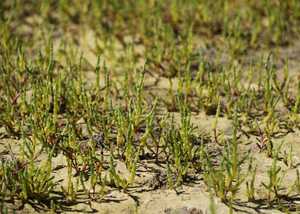
The lagoon is extremely sheltered from wave action and has weak tidal streams, except in the eastern narrows and entrance channel. The tidal range is much smaller, and the temperature range far greater than on the open coast. The lagoon supports extensive populations of two species of eelgrass Zostera and three species of tasselweed Ruppia, including the rare spiral tasselweed R. cirrhosa, and a diverse fauna that includes a number of nationally rare and scarce species.
1210 – Annual vegetation of drift lines
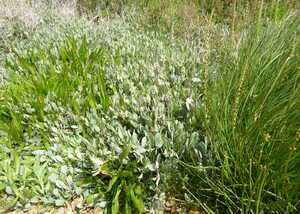
Chesil Beach is a large (28 km-long), relatively undisturbed shingle bar, and is one of two representatives of the annual vegetation of drift lines on the south coast of England. The inner shore of the beach supports extensive drift-line vegetation dominated by sea beet Beta vulgaris ssp. Maritima and orache Atriplex spp. This community exists in a dynamic equilibrium with the perennial shrubby sea-blite Suaeda vera community typical of 1420 Mediterranean and thermo-Atlantic halophilous scrubs (Sarcocornetea fruticosi), for which this site has also been selected.
1220 – Perennial vegetation of stony banks
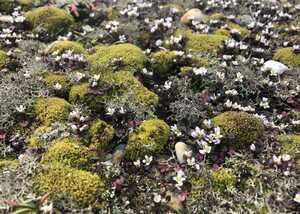
The shingle bar of Chesil Beach, including Portland Harbour shore, is an extensive representative of Perennial vegetation of stony banks on the south coast of England, and most of it is relatively undisturbed by human activities. Much of the shingle bar is subject to wash-over and percolation in storm conditions and is therefore sparsely vegetated. It supports the most extensive occurrences of the rare sea-kale Crambe maritima and sea pea Lathyrus japonicus in the UK, together with other grassland and lichen-rich shingle plant communities typical of more stable conditions, especially towards the eastern end of the site.
1420 – Mediterranean and thermo-Atlantic halophilous scrubs
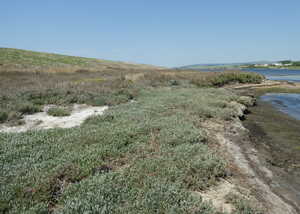
Chesil and the Fleet contains a major concentration of Mediterranean and thermo-Atlantic halophilous scrubs in the UK. A band of shrubby sea-blite Suaeda vera and sea-purslane Atriplex portulacoides lines much of the 13 km length of the seaward margin of the Fleet. The community forms a clear zone between the Fleet and the shingle vegetation of Chesil Bank. It appears to exist in a dynamic equilibrium with Annex I type 1210 Annual vegetation of drift lines dominated by sea beet Beta vulgaris ssp. Maritima, for which the site is also selected. This replaces the scrub in areas subject to disturbance and, in turn, is displaced by the scrub after disturbance ceases.
1330 Atlantic salt meadows (Glauco-Puccinellietalia maritimae)
Atlantic salt meadows develop when halophytic vegetation colonises soft intertidal sediments of mud and sand in areas protected from strong wave action. This vegetation forms the middle and upper reaches of saltmarshes, where tidal inundation still occurs but with decreasing frequency and duration.
Special Protection Area
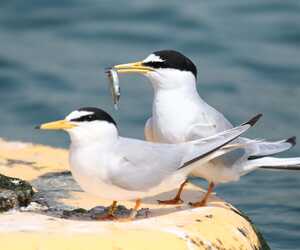
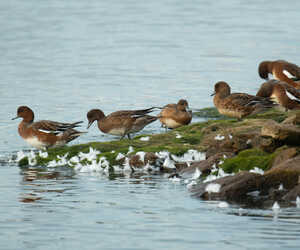
The Chesil Beach and Fleet Lagoon were designated a SPA in July 1985 in recognition of their importance for birdlife. The site is vital for both breeding and overwintering birds, supporting internationally important populations, particularly wintering Wigeon and a breeding colony of Little Tern.
SPAs are strictly protected under Article 4 of the EC Birds Directive, which came into force in April 1979. They are designated to protect rare and vulnerable birds (as listed in Annex I of the Directive) and regularly occurring migratory species that depend on these habitats for feeding, breeding and shelter.
RAMSAR
The Fleet is designated as a Ramsar site, recognised as an internationally important wetland of exceptional ecological value. Its extensive saltmarshes, reedbeds and sheltered lagoon habitats support a rich diversity of wildlife and play a vital role in the wider coastal ecosystem.
The site is internationally significant for its wintering waterfowl populations, including ducks, geese, and swans, which rely on the Fleet for feeding and shelter during the colder months.
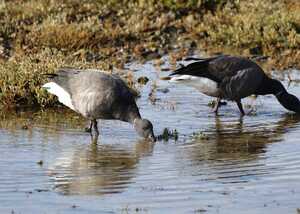
In particular, the area supports an important number of wintering Brent Geese, for which the site is of notable international importance. In addition, the Fleet is nationally important for its breeding bird assemblages, providing safe and productive habitats for a range of species during the nesting season.
The Ramsar Convention on Wetlands is an international agreement established in 1971 in the city of Ramsar, Iran. The Convention provides a global framework for the conservation and wise use of wetlands, recognising their importance for wildlife, people and the natural environment.
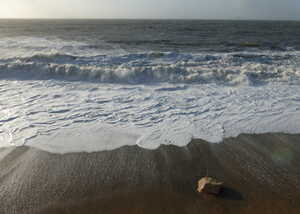
Marine Conservation Zone
The deep waters in Lyme Bay off Chesil form part of the Chesil Beach and Stennis Ledges MCZ. Designated in 2013, it protects a range of intertidal rock and gravel habitats along Chesil Beach, as well as the offshore reefs of the Stennis Ledges.
The area includes a variety of underwater features, from large boulders colonised by boring sponges to rocky ledges rich in sponges and corals.
Dorset has six Marine Conservation Zones, designated to protect rare and vulnerable marine habitats. Together, they form part of a wider network of protected sites around the UK coastline.
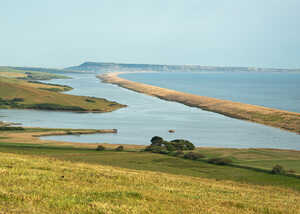
Jurassic Coast UNESCO World Heritage Site
Chesil Beach and the Fleet Lagoon form part of the Dorset and East Devon Coast World Heritage Site, recognised internationally for its outstanding geological importance.
Known as the Jurassic Coast, the site tells a near‑continuous story of around 185 million years of Earth’s history, visible in the cliffs, beaches and landforms along the coast. The Chesil and Fleet area is an important part of this story, with unique coastal features shaped by powerful natural processes over millions of years.
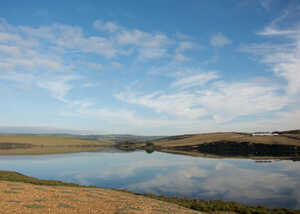
Dorset National Landscape
The western half of Chesil and Fleet forms part of Dorset’s National Landscape, previously known as an Area of Outstanding Natural Beauty. The Dorset National Landscape is a remarkably rich and varied area where exceptional wildlife, dramatic geology and human history all meet.
It contains an unusually high proportion of Britain’s species thanks to its warm climate and tightly packed mix of habitats. Its coastline forms part of the Jurassic Coast, revealing 185 million years of geological history, while the inland landscape holds evidence of human life from the Bronze Age to the present. This same landscape has long inspired writers and artists.
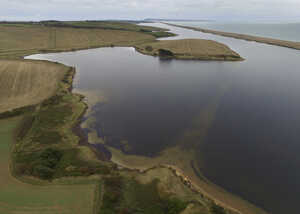
Geological Conservation Review
The Chesil and Fleet area includes sites recognised through the GCR, an initiative led by the Joint Nature Conservation Committee (JNCC).
GCR sites are identified for their nationally and internationally important geological and geomorphological features, helping to showcase Britain’s diverse geological history.
Key GCR sites along Chesil and the Fleet include Chesil Beach, Shipmoor Point / Berry Knap, Tidmoor Point, Langton Hive Point, the Herbury Peninsula, Lynch Cove, and Ferrybridge.
Bass Nursery Area
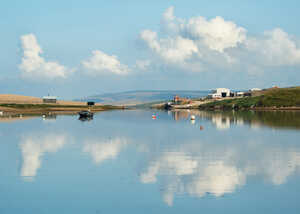
All tidal waters of the Fleet inside Ferrybridge are deemed a Bass Nursery Area. This designation sets minimum landing sizes of Bass, restrictions on the use of specific nets and the prohibition on bass fishing for all or part of the year. For further information, please visit the Southern Inshore Fisheries and Conservation Authority (SIFCA) website:
 Updating page...